Category Archives: voting technology
“Suggested Principles for State Statutes Regarding Ballot Marking and Vote Tabulation”
This letter, signed by 20 election cybersecurity experts, was addressed to the Pennsylvania State Senate Committee on Government in response to a request for policy advice, but it applies in any state — especially those that use Ballot Marking Devices for all in-person voters: Georgia and South Carolina; most counties in Arkansas, New Jersey, and West Virginia; some counties in Texas, Tennessee, Indiana, Ohio, Pennsylvania, Kansas, Nevada, and California.
Executive Summary
We believe that the goal of laws, regulations and directives relating to elections must be focused on fairness, security, transparency, and accessibility. Each state should strive to approach the gold standard in every category, so that no reasonable candidate or party may have grounds to object that the process was unfair, insecure, or compromised. The process must be transparent, so the public may be assured the winners won and the losers lost.
We believe that no system is perfect, with each having trade-offs. Hand-marked and hand-counted ballots remove the uncertainty introduced by use of electronic machinery and the ability of bad actors to exploit electronic vulnerabilities to remotely alter the results. However, some portion of voters mistakenly mark paper ballots in a manner that will not be counted in the way the voter intended, or which even voids the ballot. Hand-counts delay timely reporting of results, and introduce the possibility for human error, bias, or misinterpretation.
Technology introduces the means of efficient tabulation, but also introduces a manifold increase in complexity and sophistication of the process. This places the understanding of the process beyond the average person’s understanding, which can foster distrust. It also opens the door to human or machine error, as well as exploitation by sophisticated and malicious actors.
Rather than assert that each component of the process can be made perfectly secure on its own, we believe the goal of each component of the elections process is to validate every other component.
Consequently, we believe that the hallmarks of a reliable and optimal election process are hand-marked paper ballots, which are optically scanned, separately and securely stored, and rigorously audited after the election but before certification. We recommend state legislators adopt policies consistent with these guiding principles, which are further developed below….
“Costs for Replacing Voting Equipment in 2024”
“Ban on counting votes from computer codes passes Georgia Senate”
The Georgia Senate voted along party lines Tuesdayto abandon the use of bar codes on ballots. Instead, ballots would be counted from the printed text or filled-in ovals next to candidate names.
Republicans supporting the bill said it would improve election security and reduce the risk of hacks or tampering that could flip votes. There’s no indication that Georgia’s voting machines have been breached during an election.
It’s unlikely that the change could be made in time for this year’s presidential election.
“The biggest challenge that a voter has is knowing that their vote was correctly recorded,” said Sen. Max Burns, a Republican from Sylvania. “Let’s eliminate QR codes. Let’s make sure that electors can read the ballot and be clear about how they voted.”
Democrats critical of the proposal said it would be expensive and impractical to implement before this November’s presidential election.
“‘Serious consequences’: Company warns Johnson County sheriff over election investigation”
The election software company at the center of Johnson County Sheriff Calvin Hayden’s long-running elections investigation hit back on Monday, warning the sheriff that a baseless investigation results in “serious consequences.”
“I fully recognize that Sheriff Hayden has placed himself and his department in the awkward position of conducting a baseless investigation for the past several years into nonexistent election fraud in Johnson County,” attorney Rick Guinn, representing the company Konnech Inc. and its CEO Eugene Yu, wrote in a Jan. 29 letter to Hayden obtained by The Star.
“Sheriff Hayden should be very careful about making public statements concerning Konnech and Mr. Yu to somehow justify his obvious waste of taxpayer dollars.”
Guinn sent the letter to Hayden less than a week after Los Angeles County agreed to pay $5 million to Yu, who sued over civil rights violations after he was arrested there in 2022 on accusations that he illegally stored poll worker data in China. The case was dropped a few weeks later, with the district attorney citing “potential bias” in the investigation.
The attorney wrote in Monday’s letter that the multi-million settlement “should send a strong message to Sheriff Hayden of the serious consequences that result from a baseless investigation into nonexistent election fraud.”
Through his office’s spokesperson, Hayden declined to comment on Monday.
Hayden, a Republican, faces re-election this year if he chooses to run. He has so far not filed for reelection but his office has indicated he plans to do so. He would face a primary challenge from Doug Bedford, a former undersheriff, in the race that so far has drawn one Democratic candidate, Prairie Village Police Chief Byron Roberson.
Yu, the Chinese-American founder of the Michigan-based company, sued L.A. County and its district attorney’s office in September. His lawyers said in a news release that Yu was subjected to a wrongful, “politically motivated arrest” that was “based solely on utterly false conspiracy theories about Chinese election interference espoused by discredited, far-right extremists.”
Yu’s arrest in Los Angeles fueled right-wing conspiracies of election fraud across the country. And it propelled Hayden’s ongoing elections investigation in Johnson County, which afterward stopped using Konnech in 2022. Johnson County had used the software only to help manage election workers; the program had nothing to do with voting or voting information.
“Trump allies seek to co-opt coming election-security case to bolster 2020 lie”
Mike Lindell, the flamboyant pillow magnate, has spent millions promoting the falsehood that the 2020 election was stolen from Donald Trump — a claim that has been roundly rejected by cybersecurity experts, government officials and numerous courts. But late last year, Lindell crowed that a federal judge had vindicated him at last.
“I get to take off my tin foil hat!” he said on a podcast hosted by former Trump White House adviser Stephen K. Bannon, removing a baseball cap covered in aluminum foil that he had worn as a prop. “You know, that’s what that judge said, we’re not a conspiracy theory guy anymore! Praise the Lord.”
The judge had said no such thing. She had not mentioned Lindell at all — or the outlandish election-fraud claims he and other Trump allies have advanced.
The people U.S. District Court Judge Amy Totenberg declared to be not “conspiracy theorists of any variety” are the largely left-leaning plaintiffs in a lawsuit that was filed in Georgia long before the 2020 election and that is slated to go to trial this week. They argue that voting machines there present security risks that state officials are constitutionally obligated to address — and they have the backing, Totenberg wrote, of “some of the nation’s leading cybersecurity experts and computer scientists.”
A favorable outcome for the plaintiffs would have extraordinary implications: Georgia, one of the swing states that decided the last presidential election, could head into the 2024 cycle with machines that a federal judge has deemed dangerously vulnerable to security breaches, at least as currently operated. Though it would be aimed at ensuring a more secure voting system, such a ruling could have unpredictable implications for the public understanding of election integrity, particularly if it is mischaracterized by those seeking to sow doubt about past and future elections.
Lindell and other MAGA-world personalities — including Trump — have long sought to harness the case to bolster the false claim that voting machines were rigged to help Joe Biden win. Now, with the trial set to begin in Atlanta, Trump allies are positioning themselves to leverage political advantage from any finding that the machines are not secure.
“It saddens me to say it, but it’s likely that any legal ruling that affirms vulnerabilities in voting technology — even in support of prudent goals, like mitigating risk — will be cynically exploited to undermine voter confidence in elections, for purely political ends,” said Edward Perez, former director for civic integrity at Twitter and a board member for the OSET Institute, a nonpartisan nonprofit that advocates for transparent open-source election technology. (Two of the plaintiffs’ experts serve on the nonprofit’s board of advisers.)
The plaintiffs in the case, known as Curling v. Raffensperger, argue that the touch-screen computers on which Georgians cast their votes are vulnerable to malicious attack and human error.They do not argue that the alleged vulnerabilities have actually been exploited — in fact, they say there is no evidence that has occurred.
Further, the plaintiffs argue that the secret copying of voting software in rural Coffee County in 2021 by Trump allies — an episode that the plaintiffs unearthed and that has since become part of the criminal indictment against Trump and others in Fulton County — exacerbated the risk to future elections by giving unauthorized individuals a virtual road map to hack into machines and manipulate results.
Marilyn Marks, executive director of the nonprofit Coalition for Good Governance, one of the plaintiffs, said Georgia must acknowledge and deal with the alleged problems with its voting system, regardless of the efforts by some to mischaracterize the case. “We cannot back down from what must be done based on what Trump or any other politician says about it,” she said in an interview….
“Voting experts warn of ‘serious threats’ for 2024 from election equipment software breaches”
An effort to access voting system software in several states and provide it to allies of former President Donald Trump as they sought to overturn the results of the 2020 election has raised “serious threats” ahead of next year’s presidential contest, according to a group of experts who urged federal agencies to investigate.
The letter sent by nearly two dozen computer scientists, election security experts and voter advocacy organizations asks for a federal probe and a risk assessment of voting machines used throughout the country, saying the software breaches have “urgent implications for the 2024 election and beyond.” The breaches affected voting equipment made by two companies that together count over 70% of the votes cast across the country, according to the letter.
“The multistate effort to unlawfully obtain copies of voting system software poses serious threats to election security and national security and constitutes a potential criminal conspiracy of enormous consequences,” the group wrote in a letter sent to U.S. Attorney General Merrick Garland, special counsel Jack Smith, FBI Director Christopher Wray and Jen Easterly, director of the U.S. Cybersecurity and Infrastructure Security Agency. “We must protect our most sacred tenet of democracy — the security of our vote.”…
Among the 22 people who signed the letter to the federal agencies was Douglas W. Jones, a computer scientist who said the effects of the various breaches were not limited to the local election offices where they occurred because the voting system software involved is used by many offices across the country. The letter says those involved accessed equipment made by two of the leading manufacturers, Dominion Voting Systems and Election Systems & Software.
“In 2024, no matter which way the election goes, election deniers on one side or the other could easily grasp on the breaches following the 2020 election and suggest that those breaches allowed the 2024 results to be cooked,” he said.
Election technology expert Kevin Skoglund, who also signed the letter, said a federal probe was necessary because many of those involved have not been investigated or been asked to give up their copies of the election software.
“Every software copy that is reclaimed reduces the risks of further distribution, disinformation and harm to the security of future elections,” Skoglund said. “There should be consequences for widely sharing parts of our national critical infrastructure or others will be encouraged to repeat these schemes.”
“Voting machine trouble in Pennsylvania county triggers alarm ahead of 2024”
Voters in the swing county of Northampton, Pennsylvania, mostly moved on after their new touchscreen voting machines glitched during a down-ballot judge’s race in 2019.
But when a similar issue cropped up earlier this month, it triggered a backlash within the county — one that has left state and local election officials in this key swing state racing to restore voter confidence ahead of what could be another contentious presidential election.
“We’re at the peak of mistrust of one another, but until that subsides, counties like ours need to be nearly perfect, and I think this system allows us to do that,” County Executive Lamont McClure told POLITICO before Northampton certified the vote on Tuesday, arguing the glitch resulted from human error.
The debate playing out in Northampton comes as election officials across the country are still contending with the consequences of Donald Trump’s 2020 fraud claims, which often centered around how votes are counted at the local level. With Trump a current frontrunner for the Republican nomination, that skepticism could only mount….
The 2019 election was the first time Northampton used the touchscreen voting machines from Election Systems & Software. That year, a programming glitch caused the ES&S machines to significantly undercount the votes for the Democratic candidate in a local judges’ race. Then on Nov. 7 this year, Northampton residents who showed up at their local polling station found that printouts from the same devices didn’t match the votes they had submitted digitally for two down-ballot judges contests.
Like in 2019, county officials and ES&S have said the errors did not affect any votes or alter the outcome of the races — both uncompetitive, up-down votes on whether to retain state judges. They argue the machines themselves are highly reliable and not to blame, saying the problem was caused by a one-off human error in the programming.
“You Can Now Read the GBI’s Coffee Co. Report in Full” and Not Everyone is Happy
Response from the Coalition for Good Governance:
CGG and its legal and voting system security advisors are extremely disappointed in the quality of the report, because of its lack of depth, delayed timing, accuracy and limited scope. We are dismayed to see how little independent or robust investigation the GBI conducted over the course of the year they looked into the largest voting system breach in the nation’s history. They conducted only 15 generally short, limited interviews over the course of their 13 months investigation, and issued few subpoenas to attempt to get relevant documents. They seemed to generally rely on our Curling case documents, which should have been only the starting point for the state with their far more extensive discovery tools and authority, not to mention their significant financial resources.
The scope of the investigation is far too limited and focused primarily on a small number of Georgia-based witnesses or breach participants. GBI apparently did not investigate many of the individuals with prominent alleged roles in the breaches’ planning and execution, both inside Georgia and those operating at a national level. The August 2022 slow start of the investigation of the Coffee County breaches, now a household term, in the wake of the Fulton County District Attorney’s indictment is inexcusable.
Secretary of State Raffensperger and the Georgia State Election Board did not conduct a meaningful investigation themselves and waited until August 2022 to seek the GBI’s assistance looking into these massive system breaches. In April 2022, the Secretary’s office represented to the federal court that it had opened an ‘active and ongoing investigation’ in February 2022, but later admitted to reporters that their “first step” (a forensic analysis of the server) wasn’t taken until late June 2022. However, claims surrounding the Secretary’s knowledge of the breach and its investigation are conflicting and confusing. Secretary Raffensperger claimed that he had investigators “digging deep” on this intrusion in early 2021, but his office cannot seem to produce any such investigative files. CGG’s litigation discovery process has produced no records to substantiate that any state investigation was begun until late June, 2022. No evidence of any interviews or document request exists before Secretary Raffensperger lateraled this uncomfortable “investigation” to the GBI in August 2022. It is disturbing that the Secretary’s office made no attempt to preserve the email and video security records in Coffee related to these crimes, and such files were purportedly “lost” for an extended time, and still have not been fully produced….
“Show Me the Ballots! To combat rampant disinformation and public distrust in elections, a bipartisan group of politicians is advocating for a radical form of transparency: post all cast ballots online.”
Steven Rosenfeld for Washington Monthly.
“Prosecutors are focused on a rural Georgia county in Trump’s 2020 election case. Here’s why”
They were running out of time and needed a Hail Mary.
Joe Biden had won the electoral college vote in the 2020 presidential election. And with less than three weeks before Congress was set to certify the results on Jan. 6, 2021, allies of then-President Trump met with him in the Oval Office to discuss taking desperate measures.
Following dozens of failed challenges to the election in court, and with plans to ask lawmakers to throw out some state results, Trump operatives including former national security advisor Michael Flynn drafted an executive order intended to allow the administration to seize voting machines. To the horror of White House lawyers, the president was being urged to sign it.
Named in two drafts of the order to help justify the seizure was Coffee County, Ga., where officials had refused to certify the results of the presidential election — a clear indicator there had been fraud, Trump’s allies argued. A last gasp in the frantic efforts to keep Trump in office, the eventual breach of election systems in the rural southeastern Georgia county would go on to become a critical part of the sweeping racketeering indictment filed in Atlanta in August alleging a broad conspiracy by the former president and 18 co-defendants.
Together, depositions and other court documents, testimony to the House Select Jan. 6 Committee and public statements made by those involved provideone of the most comprehensive accounts to date of what happened in Coffee County —and the role it played in the final days of the futile endeavor to ensure Trump remained in the White House.
As the now-infamous Dec. 18 Oval Office gathering devolved into a chaotic, hours-long shouting match between Trump operatives and the White House lawyers, Trump attorney Rudolph W. Giuliani stepped in to wave the president off from signing the executive order. “Voluntary access” to a Georgia voting system was in the works, Giuliani told Trump, according to testimony before the Jan. 6 committee, making the order unnecessary.
It was part of a new strategy, Giuliani said on former Trump advisor Stephen K. Bannon’s podcast the next day, to use evidence obtained from voting machines to circumvent Republican governors — like Brian Kemp of Georgia — who were unwilling to continue investigating allegations of fraud. “Just push ’em aside,” Giuliani said.
It’s unclear whether Giuliani noted where in Georgia that access would be provided. But shortly before the contentious Oval Office meeting, he had met with an unnamed “whistleblower” a block away at the storied Willard InterContinental Washington. Giuliani associate Bernard Kerik paid for that person’s room…..
“Why Did Sidney Powell Plead Guilty?”
In rural Coffee County, Georgia, three and a half hours southeast of Atlanta, at least a few employees of the election office agreed. After a recount of Georgia’s votes was completed, on December 4th, the county’s elections supervisor, Misty Hampton, refused to certify the results, saying that the machines were unreliable. Days later, a local news outlet posted a video on YouTube in which Hampton is seen demonstrating how the machines could supposedly be used to flip votes. The video presented a potential source of evidence for Powell and others advancing claims of a Dominion conspiracy. But they would need to access the county’s voting software to find any smoking guns.
On January 7, 2021, the day after a right-wing mob stormed the Capitol building, several people paid a visit to the Coffee County elections office. A year and a half later, the Georgia Bureau of Investigation began formally looking into allegations that “computer trespass” had taken place that day. The delay seems to have been due to resistance from the Georgia secretary of state’s office, which, for months, denied that a breach had occurred. “There’s no evidence of that—it didn’t happen,” Gabriel Sterling, a top official with the office, said, in April, 2022. (When asked about the delay by The New Yorker, a spokesperson for the office said, “We took decisive action to address it and give voters peace of mind once we had solid evidence. Misty Hampton is no longer the elections director and all elections equipment has been replaced.”) As the secretary of state deflected, an elections-watchdog group, the Coalition for Good Governance, obtained discovery rights and began issuing subpoenas. The group’s computer-forensics expert confirmed that Coffee County’s elections server had been breached. The chair of Georgia’s state-elections board at the time, a former federal judge named William Duffey, pushed, more than once, for the F.B.I. to get involved. But the agency punted, deferring to the G.B.I., despite the smaller agency’s modest resources and inability to cross state lines.
A year after the G.B.I. investigation began, Powell and eighteen others, including Donald Trump, were indicted elsewhere in Georgia, in Fulton County, as co-conspirators under the Georgia Racketeer Influenced and Corrupt Organizations Act (rico). Fulton County’s prosecutor, Fani Willis, aims to prove that there was collusion to overturn the outcome of the 2020 election. Powell, who was charged with seven felonies and was facing up to twenty years in jail and six-figure fines, demanded a swift trial, which would have allowed her to get ahead of evidence likely to come out later, when others are tried. But, on Thursday, in a surprise move, she pleaded guilty to six misdemeanor counts of intentional election interference. She will have to pay nearly nine thousand dollars in fines, be on probation for six years, and testify on behalf of the prosecution if called upon; she also has to write a letter of apology to the people of Georgia. Her plea stems from her apparent culpability in the theft and dissemination of voting-machine software, election data, and ballots in Coffee County.
The New Yorker recently obtained a copy of a nearly four-hundred-page summary report produced by the G.B.I., detailing the Coffee County scheme, which has not been made public. The report, much of it relying on information gathered by the Coalition for Good Governance, offers a fuller picture of both the breach at the election office and how that breach was connected to the larger effort to overturn the 2020 election. That effort centered on the work of Sidney Powell….
This fall, Powell’s lawyer, Brian Rafferty, asked Judge Scott McAfee, who is overseeing the Fulton County rico case, to sever Powell’s case from that of Ken Chesebro, an attorney implicated in a separate scheme, involving fake electors, who also chose a speedy trial. (Chesebro pleaded guilty the day after Powell did so.) Powell’s case “boils down to one day, January 7th,” Rafferty said. “That’s it. The whole case is about whether or not that visit was authorized and what if any role she had in it, which is very little, if none.” The G.B.I. report complicates that argument, since it makes clear that the breach took place on more than one day, and that Powell paid for the initial activity. Her name, as the report shows, appears on the engagement letter with SullivanStrickler.
A few weeks later, Rafferty tried another strategy, this time asking the court to decide whether, under Georgia law, Coffee County officials “had authority to allow the forensic imaging of the machines” and “to conduct follow-up testing of them.” But, had Powell done due diligence, as the contract she signed with SullivanStrickler required, she would have known that the Georgia administrative code explicitly forbids anyone but employees of the election board to enter rooms where the election-management system or election equipment is stored. A few days after Rafferty made his new request, Powell pleaded guilty. (Neither Rafferty nor Powell responded to a request for comment.)
“Inside Mike Lindell’s ‘plan’ to sound false cyber-attack alarms at local polls”
Lindell’s quest is decidedly quixotic, beyond the fringe to some, particularly in light of outsized voting-fraud claims made by right-wing election vigilantes, such as True the Vote, that have consistently withered under scrutiny and failed to materialize around Election Day.
But there is a method to Lindell’s mayhem, which is both relentless and accepted as bedrock truth by a subset of Trump’s most ardent and impressionable supporters. With this comes a real danger of inciting more threats to elections officials, distrust of elections, generally, and civil strife. Come 2024, thousands of like-minded local activists may be receiving deeply misinformed messages — via Lindell’s social media network that their local polls and county election headquarters might be under an active cyber-attack.
At the Springfield conference center, Lindell, the ringmaster, instructed everyone to look at the big screen. A video camera from a drone hovered above the building. The drone approached it and flew into its lobby, and then into the large meeting room. It landed on a table on the stage where Lindell sat in front of a banner with a badge-shaped “Election Crime Bureau” logo.
The room cheered as Lindell removed and displayed its cargo. He held up a small, dark gray, electronic gadget with a blue, wallet-size screen. The gadget, he said, would prove that computers and devices used at America’s polling places and election headquarters were connected to the internet, were going online and offline, and, thus, could be invisibly manipulated from afar by their political enemies – who he frequently called the “uni-party,” meaning anti-Trump Democrats and Republicans.
“What if I told you that there was a device that had been made for the first time in history that can tell you that the machine was online?” Lindell said. “And then you could tell what the device was, where it was at, what the name of it was – ES&S 60503 – and you knew the second it went online. Well, this is what we’ve been working on for over a year. And I’m going to show you.”
He played a short video with a British-accented narrator who described what he called the “Wireless Monitoring Device.”
As the narrator told it, this WMD — not to be confused with the common acronym for “weapon of mass destruction” — was more than a box listing WiFi signals like one’s phone. It would find and identify “access points,” “routers”, “printers,” “computers,” “phones” and other devices using WiFi. It would identify their makes, models and serial numbers. It would detect online commands that engaged polling station electronics.
It would not, however, interfere with data transmission. Rather, it would send, in less than a minute, all of the detected information to a nationwide hub – the “Election Crime Bureau.” This Election Crime Bureau, in turn, would send alerts and texts via an app to activists living near the surveilled sites.
“You get the gist of the reporting, right?” Lindell said. “You’re gonna sit in your easy chair on your phone or whatever. And you’re gonna see real-time crime coming. You’re gonna know what a box [election computer] goes live. You’re going to know when a router goes live, when a polling book goes live and everything, okay… We will now become a policing of our own election.”
Lindell would not reveal where the Election Crime Bureau was located nor who would be staffing it….
We’ve Issued a Major New Report, “24 for ’24: Urgent Recommendations in Law, Media, Politics, and Tech for Fair and Legitimate 2024 Elections”
Back in March, the UCLA Law Safeguarding Democracy Project held a conference, Can American Democracy Survive the 2024 Elections?
Following the conference some of the participants met as an ad hoc committee to consider recommendations in law, politics, media, and tech for fair and legitimate elections in 2024. The goal was to convene a cross-ideological, interdisciplinary and broadly diverse group of election experts to consider ways to bolster both the actual fairness of the upcoming elections as well as public confidence in them.
Today, under the auspices of SDP, the 24 members of the Ad Hoc Committee for 2024 Fairness and Legitimacy released a new report: 24 for ’24: Urgent Recommendations in Law, Media, Politics, and Tech for Fair and Legitimate 2024 Elections.
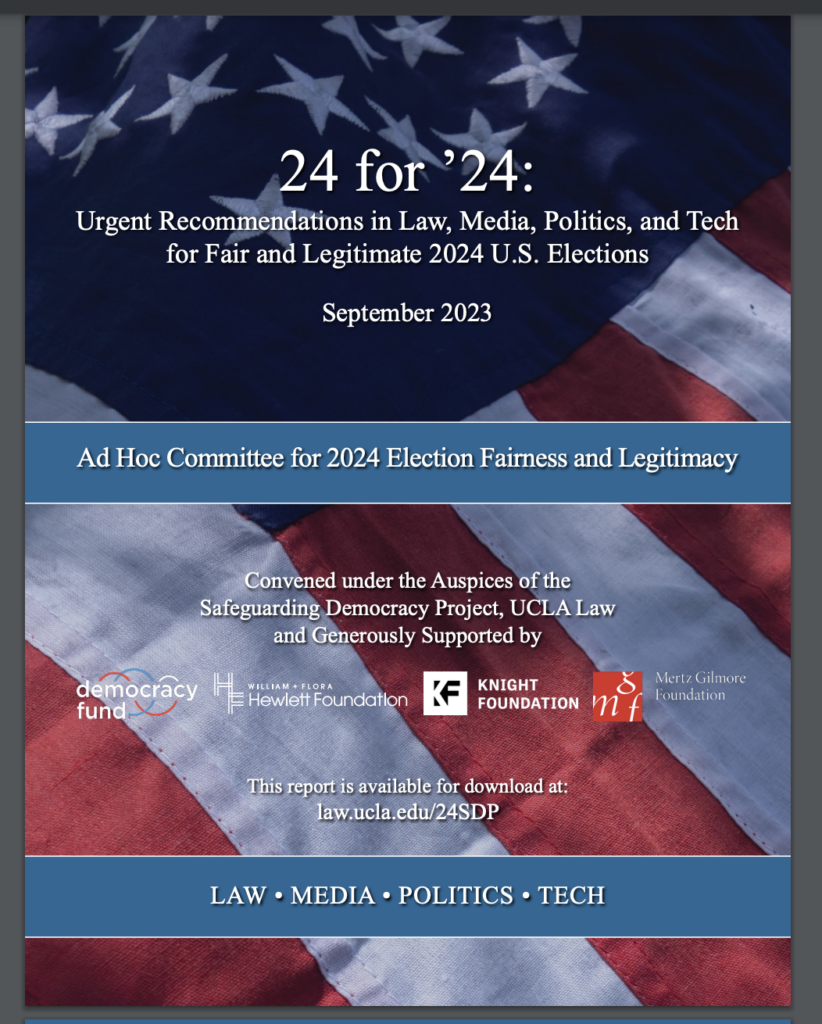
Here are what I see as some of the key takeaways of the report:
- The United States’ election system continues to be under great stress, especially after the last election was conducted during a pandemic and with unprecedented attacks on the integrity of the election system. There are reasons to worry 2024 could be worse
- SDP convened a group that is really ideological diverse and is multidisciplinary, with scholars and leaders in law, media, politics and norms, and tech
- 24 leaders came up with 24 recommendations for fair and legitimate 2024 elections; all of these can be put in place before the 2024 elections
- Recommendations aimed not only at fair elections but at public acceptance of results across the political spectrum
- Recommendations made to journalists, social media companies, government bodies, election officials, bipartisan Congressional and state leaders committed to democracy and the general public
- Among key recommendations: states need to draft laws now to deal with how to handle election emergencies; courts need to resolve as soon as possible challenges to the qualifications of candidates to run for President under the Fourteenth Amendment; news organizations need to invest resources into training journalists on how elections are run, especially local and non-English language news outlets; election administrators need to harden their systems against “insider threats”—the actions of election workers or officials attempting to sabotage results
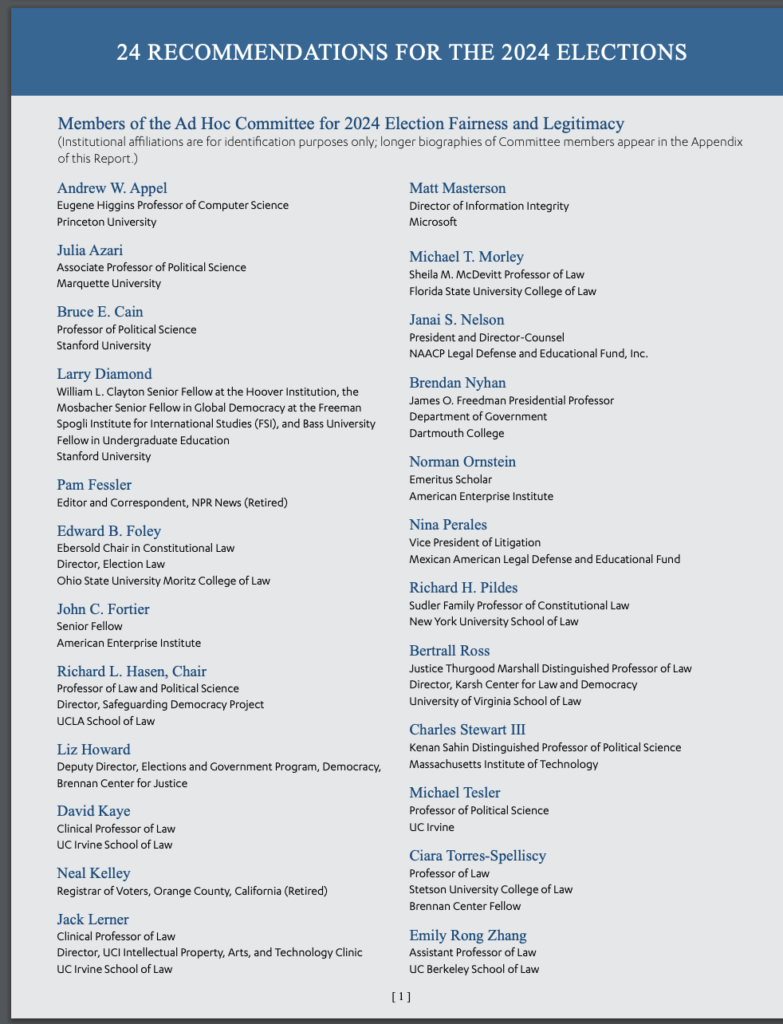
Below the fold, I share the summaries of the 24 recommendations; full recommendations are in the report itself. In upcoming weeks, we will look for opportunities to share our recommendations with specific constituencies to whom they are addressed.
In early news coverage, Zach Montellaro of Politico writes, “Election Experts Warn American Democracy is ‘Under Great Stress’ Ahead of 2024.” Read the full report for details.
Continue reading We’ve Issued a Major New Report, “24 for ’24: Urgent Recommendations in Law, Media, Politics, and Tech for Fair and Legitimate 2024 Elections”