The state’s residents have long been a close mix of Democrats and Republicans, which makes Wisconsin a crucial swing state in presidential elections and means statewide races are often fiercely contested. The reshaping of the maps is expected to suddenly return many legislative races to the realm of true competition as well.
After more than a decade of languishing in the minority in the State Legislature, Democrats are now in a position to vie for political power with the Republicans, who currently hold about two-thirds of the seats in both the Senate and the Assembly.
“We are on offense,” said Representative Greta Neubauer, a Democrat and the minority leader of the State Assembly. “We absolutely see a path to the majority.”
The new maps — ordered by the Wisconsin Supreme Court in December after finding the previous ones unconstitutional — reflect a near-split between Democratic- and Republican-leaning districts: 45 are Democratic-leaning, 46 are Republican-leaning, and eight are likely to be a tossup.
Democrats would need to flip 15 seats to gain a majority in the Assembly, though they do not view the State Senate — whose elections are staggered — as within reach this year.
Category Archives: redistricting
“Supreme Court Rejects Bid to Revive Washington State Voting Map Said to Hurt Hispanics”
The Supreme Court refused on Tuesday to reinstate a voting map for the Washington State Legislature that a federal judge had found discriminated against Hispanic voters.
As is the court’s custom when it acts on emergency applications, its brief order gave no reasons. There were no noted dissents.
The case arose from a lawsuit by Hispanic voters who challenged a voting district in the Yakima Valley region that had been drawn by the state’s independent redistricting commission after the 2020 census. The plaintiffs said the district violated the Voting Rights Act by diluting their ability to elect their preferred candidates.
The case had some unusual features, notably that a majority of the challenged district’s voting age population was Hispanic…..
“The fight to flip the House just got harder for Dems. And they have New York to blame.”
Zach Montellaro for Politico:
Republicans eked out a narrow win in the 2024 redistricting wars, gaining a single seat before the general election.
While there’s an outside chance of another last-minute redistricting before November, after two significant court rulings this week the House landscape is largely locked in place — and the GOP is breathing a sigh of relief that this mid-decade round of redistricting went its way.
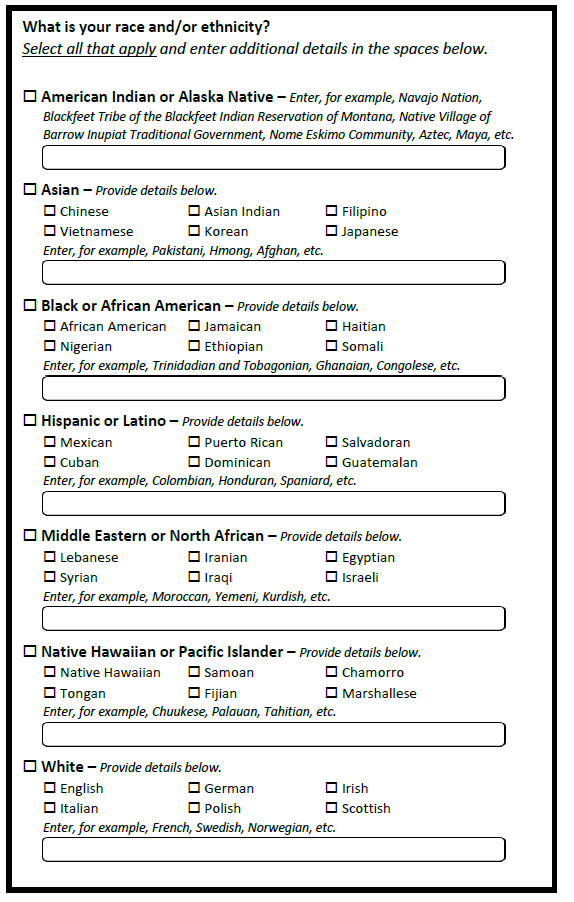
New OMB race/ethnicity categories
Justin here. This is a really big deal: the federal government’s got new standards for collecting data on race and ethnicity.
The Office of Management and Budget has a sneak preview today of tomorrow’s update of “Statistical Policy Directive No. 15: Standards for Maintaining, Collecting, and Presenting Federal Data on Race and Ethnicity.” SPD 15 was initially developed in 1977 to help provide consistent data on race and ethnicity throughout the federal government, and drives all kinds of data collection in all kinds of contexts, including the Census, redistricting, and VRA claims. It was updated once in 1997, and this is a long-awaited version 3.0.
There are some big changes in the new standards, but the biggest include combining a question on Hispanic/Latino heritage along with other categories in one race-and-ethnicity question (the previous approach purported to separate race in one question and Hispanic/Latino ethnicity in another); adding a Middle Eastern or North African (MENA) category; and collecting detailed subgroup information within each category as a default.
Among other impacts, in applications like the Census and intercensal questionnaires, these standards will likely continue to help more accurately reveal how multiethnic we are. (Past methodology changes have already given us a far more accurate picture than we used to have: some of the country’s diversification is due to demographic change, but an awful lot is due to better capacity to recognize how diverse we already were, in ways hidden by our measurement instruments.) I’ve written a bit on this in the context of the Census, SPD 15, and the ways that our tools have changed over time.
There are variations available for specialty uses, but here’s what the standard new data collection will look like:
“South Carolina latest state to use congressional map deemed illegal”
Patrick Marley for WaPo:
In a scenario that has played out in three states in recent years, a federal court ruled Thursday that time had run out to draw a new congressional district in South Carolina and that the state would have to proceed this fall with an existing election map the court had previously deemed illegal.
The ruling echoes redistricting cases in other Southern states where courts found that congressional maps violated the voting rights of Black voters and other people of color but allowed them to be used anyway, at least temporarily. In recent years, that happened in Alabama, Georgia and Louisiana.
In the latest instance, a panel of three judges decided to let South Carolina use a new map drawn by the Republican-led legislature because the Supreme Court had not yet decided an appeal that will ultimately determine how the district should be drawn. Voting rights advocates decried the ruling, saying it is unjust to hold even one election in districts that are unconstitutional.
“Once an election happens, you kind of can’t get back that election,” said Leah Aden, senior counsel for the NAACP Legal Defense Fund, which brought the South Carolina lawsuit.
The ruling came a day after a different federal court upheld a congressional map in Florida that favors Republicans and erases a seat held by a Black Democrat.Those decisions, along with others in recent months, mean the congressional maps for 2024 are largely set. Republicans narrowly control the House, and voters this fall will decide whether to let them keep it.
Also Thursday, a federal appeals court issued a ruling that all but ensures North Carolina will use state legislative maps this fall that Democrats and voting rights advocates say dilute Black representation in the statehouse.
Michael Li, senior counsel for the Brennan Center’s Democracy Program, said appeals take so long that states sometimes get a chance to use illegal maps for one or two election cycles before they are forced to draw new ones.
“It’s becoming more common,” he said. “Courts used to go out of their way to have voters not vote on a map that had been deemed illegal. Now, unless you get everything resolved, you have to vote on a map that is illegal. The courts can undermine voters’ rights through the process.”…
“Federal court rejects congressional redistricting challenge as state lawsuit awaits Florida Supreme Court”
A three-judge federal panel unanimously upheld a controversial congressional map backed by Gov. Ron DeSantis, despite accusations he and the Legislature discriminated against Black voters.
The judges agreed that the plaintiffs failed to show the Legislature was discriminating when it approved Gov. DeSantis’ map.
“It is not enough for the plaintiffs to show that the Governor was motivated in part by racial animus, which we will assume without deciding for purposes of our decision,” the court wrote. “Rather, they also must prove that the Florida Legislature itself acted with some discriminatory purpose when adopting and passing the Enacted Map. This they have not done.”
The lawsuit targeted DeSantis’ efforts to dismantle a congressional district in North Florida, a district that enabled Black voters to elect their preferred candidates for three decades.
“South Carolina Republicans ask justices to let district ruled a racial gerrymander go forward”
Amy Howe for SCOTUSBlog:
Telling the justices that if they do not intervene they will create “confusion and uncertainty over this year’s elections,” a group of Republican lawmakers from South Carolina came to the Supreme Court this week, asking the justices to block a ruling by a federal court holding that one congressional district in the map adopted by the state’s Republican-controlled legislature was an unconstitutional racial gerrymander. With the primary elections looming, the legislators contend, the state’s 2024 congressional elections should be allowed to go forward as scheduled using the map adopted by the legislature.
The dispute centers on the map adopted by the South Carolina legislature in 2021 for the state’s seven seats in the U.S. House of Representatives. The map moved nearly two-thirds of the Black voters in Charleston County out of District 1, which is currently represented by Republican Nancy Mace, into District 6, which is represented by Democrat Jim Clyburn. The new map also moved Republican areas in three nearby counties from District 6 into District 1.
The petition is here.
It seems to turn Purcell on its head, arguing that the Court should intervene to change the status quo when the district court refused to do so.
Wilfred Codrington in Balkinization Symposium on “A Real Right to Vote:” “A [More] Real Right to Vote”
Wilfred’s post on my book, A Real Right to Vote:
Many congratulations are due to Professor Richard L. Hasen on the publication of his newest book, A Real Right to Vote: How a Constitutional Amendment Can Safeguard American Democracy. In this short book that seeks to address not-so-sweet problems, Hasen seamlessly weaves anti-canonical election law cases with modern stories of anti-democracy (some of which have yet to reach their conclusions) to explain the utility of a Right to Vote (“RTV”) Amendment today. In general, I am happy to read this work, as it adds a distinguished voice to the growing chorus that signs the praises of a RTV Amendment. An idea that was once looked upon as extraneous, unworkable, or even a pipe dream seems to be gaining more traction in the scholarly community. Even still, my sense is that Hasen’s proposals—both the basic and extended versions—do not go far enough in an important respect. Any discussion of an effective right to vote that disregards the problem of partisan gerrymandering, to me, seems incomplete.[1] And having gone back to review some of Hasen’s older works, I am persuaded that, even on his terms, there are at least three reasons why the basic amendment should include a provision to address the concern of partisan gerrymandering….
“Supreme Court’s Delay Creates Uncertainty for South Carolina Election”
Jimmy Hoover for National Law Journal:
New candidates are throwing their hats in the ring in Republican Rep. Nancy Mace’s South Carolina congressional district despite a court ruling last year striking down the GOP drawn map as an unconstitutional “racial gerrymander.”
Both GOP state lawmakers defending the state’s newly drawn First Congressional District and challengers from the South Carolina State Conference of the NAACP had hoped the U.S. Supreme Court—which heard arguments in October—would have completed its review of that decision by Jan. 1.
As it stands, key primary deadlines are fast approaching without word from the high court on whether new district lines drawn after the 2020 census are valid.
“I know that originally there was talk of trying to get it out early before the primaries, but the court doesn’t seem to be in much of a hurry with anything this term,” said Rick Hasen, an election law professor at UCLA Law.
At stake in the case is whether Republicans can hold on to a 1.36 point partisan advantage from the new map or whether the state General Assembly will have to go back to the drawing board to satisfy the demands of a federal district court panel that struck down the map as unconstitutional. The panel found the new map illegally moved Black voters into a nearby district to maintain a low Black voting age population.
The panel has said it would allow the Supreme Court to complete its review, expressed hope a remedial plan could be adopted before the coming elections and entertained pushing back any elections until an alternative map is put in place.
“Republicans Hatched a Secret Assault on the Voting Rights Act in Washington State”
Republican Paul Graves’ work was about to come undone. In the wee hours of Nov. 15, 2021, he and his fellow Republican on Washington state’s independent redistricting commission had finally prevailed on their Democratic counterparts to agree to the maps voters would use in the upcoming election.
But then Latino voters sued the state, claiming the new legislative maps didn’t give them voting power commensurate with their population. Now, Graves worried, a federal judge was about to force the state to give Democratic-leaning Latinos more voting power.
With the balance of power in Washington up for grabs, he launched a covert attack. He consulted powerful state Republicans. He reached out to national Republicans, including the most influential conservative redistricting lawyer in the country, to discuss funding a lawsuit and get strategic advice. He conferred with a Seattle law firm. And he found a Latino congressional hopeful to act as the face of the lawsuit.
A countersuit was filed — against Graves’ own work. This suit made the opposite argument from the Latino group’s. Yes, the map that Graves and his fellow commissioners had created discriminated. But it had disadvantaged white people and other voters.
Sure enough, as Graves had foreseen, in August of last year the judge sided with the Latino plaintiffs. He determined the Yakima Valley map violated the Voting Rights Act, the landmark 1965 civil rights law that has been the bedrock of voting discrimination cases for over half a century. Section 2 of the VRA prohibits the creation of election districts that deprive voters of color of their full rights. The judge said the maps needed to be redrawn.
Having handed Latinos a win, the judge tossed the lawsuit that Graves had helped generate as moot. Undeterred, the legal team of Benancio Garcia, the Latino congressional hopeful, appealed all the way to the U.S. Supreme Court, asking it to block the new maps until it had weighed the merits of his claim. The court declined to take the case earlier this month, and it is unclear whether lawyers will now appeal to the 9th U.S. Circuit Court of Appeals.
Graves told ProPublica he wanted legal action that would slow down the court because he believed the plaintiffs were about to push through “a naked partisan gerrymander.”
“My singular goal, once a lawsuit was filed, was to defend the maps,” he said in a statement. His work is described in sworn depositions and court documents, including emails and other communications introduced as exhibits.
“Wisconsin Supreme Court rejects move to reconsider state’s congressional maps”
The Wisconsin Supreme Court on Friday rejected a request to reconsider the state’s congressional maps ahead of the next election, ensuring the current district boundaries will remain in place for 2024.
The court’s decision ends a last-minute push from Democrats to change the state’s congressional maps after they successfully signed into law new legislative boundaries last month that weakened Republicans’ grip on the state Legislature.
“This motion comes as no surprise after the court’s new majority telegraphed its willingness to rebalance political power in the state of Wisconsin by overturning Johnson v. Wisconsin Elections Commission,” conservative Justice Rebecca Bradley wrote in the order, referencing the court’s previous decision on the maps.
“While the court rightfully denies this motion,” she added, “it likely won’t be long until the new majority flexes its political power again to advance a partisan agenda despite the damage inflicted on the independence and integrity of the court.”
Newly elected liberal Supreme Court Justice Janet Protasiewicz did not participate in a vote on the motion, writing Friday that she was not seated on the court when the underlying case was decided. Chief Justice Annette Ziegler joined Bradley in her concurring opinion rejecting the request to consider new maps.
You can find the order here (via Democracy Docket).
“Democrats Blew Their Big Opportunity to Make New York Winnable in 2024”
After over a year in court, millions of dollars on lawyers’ fees, an overhaul of the state’s highest court, and an all-out battle to throw out New York’s congressional districts and replace them with something more favorable for Democrats, the New York Senate, empowered with the ability to flip control of the House single-handedly, voted to confirm new maps, signed by the governor into law. The result: The number of Trump-won districts in the state has officially increased from five to six.
Read that again. Not a typo! The most anticipated Democratic gerrymander of the 2024 election cycle has resulted with Democrats—wielding supermajority control of the Legislature and a newly enshrined liberal majority on the state’s highest court—actually increasing the number of congressional districts in areas won by a Republican in 2020. They made swing districts like NY-01 even redder, likely putting them out of reach for Democrats. (Swingy NY-19, too, is ever so slightly redder than before.) The new map is barely distinguishable from the 2022 map that contributed to New York Democrats’ disastrous midterms performance and gave the Republicans the House majority….
Charitably, New York Democrats were probably afraid that if Republicans sued successfully, a court could redraw the map with no solicitude for Democratic incumbents. They were trying to protect themselves, with little concern for national Democrats. But if Republicans had sued to thwart a gerrymander and won, the cost would have been minimal: The Legislature would merely have to try again. Instead, it didn’t even try, choosing instead to shore up its individual fates at the expense of the party broadly. New York Democrats never miss an opportunity to miss an opportunity, and that truth is etched into this map. What was the point of flipping the court, of bringing the lawsuit, of all of it?
“It’s absolutely astonishing. We’ve seen how feckless NY Dems have been in so many ways for so many years—decades, really—so I’m disgusted more than I am surprised,” said David Nir, publisher of Daily Kos Elections, which closely tracks redistricting efforts. “If it’s better than the ’22 map, it’s barely any better.”
“NY Gov. Approves Bill Directing Redistricting Suits to NY’s Major Metropolitan Courts”
An amended bill that limits New Yorkers to filing redistricting lawsuits in Manhattan and Albany, Westchester and Erie counties was signed into law by Gov. Kathy Hochul on Wednesday, after the Assembly approved it earlier in the day, while the Senate had passed it on Monday.
Bill sponsors say S3292B/A435A is aimed at preventing forum shopping and to designate those courts as experts in redistricting matters.
But the controversial proposal drew a more-than hourlong debate on Monday in the Senate, with Republican opponents asserting the bill would harm New Yorkers who don’t live near the four designated counties.
New York elections attorneys continue to monitor the bill, which originally targeted Albany County for hearing redistricting cases throughout New York’s 62 counties.
Cozen O’Connor senior counsel Jerry Goldfeder, a prominent elections attorney, told the Law Journal in an interview that the bill makes sense.
“It’s an attempt to make certain that courts in the major population areas hear cases that relate to the entire state, as opposed to state supreme court justices in counties with very few people, that make it very difficult for people to attend,” Goldfeder said….
“Shadow disticts”
Quinn Yeargain has written this article for the Cardozo Law Review. Here is the abstract:
Redistricting disputes—for congressional, state legislative, and local districts—have proven all-consuming in politics. Litigation over the legality of districts, under both federal and state law, is near constant when decennial redistricting occurs. But largely omitted from redistricting litigation and scholarship, however, are the districts drawn to elect members of statewide boards. These boards have outsized authority over some of the most salient disputes in politics today, with state boards of education setting policies for what can be taught in classrooms and how LGBT students are treated by the public education system, public utility commissions adopting policies for renewable energy production and decarbonization, and executive councils playing a key role in checking the powers of state governors.
Despite the significant policymaking authority of these boards, the districts used to elect them are all too frequently ignored during decennial redistricting. Partisan gerrymandering claims are increasingly brought against congressional and state legislative districts, but hardly ever against state board districts. Racial justice groups frequently push for the creation of new minority-opportunity districts for Congress, state legislatures, and even municipal bodies, but hardly ever for state boards. And in some cases—most notably, Mississippi and Montana—these districts haven’t been redrawn at all.
In this Article, I argue that the omission of state boards from redistricting litigation and conversations is a grave failure of democracy. I explore how representational progress in state democracy has largely left state boards elected by district behind. To do this, I build out a full legal history of these boards, drawing on my own comprehensive database of state elected offices, which tracks every creation, abolition, and redistricting of state boards from 1776 to the present. I map the inauguration of the one-person, one-vote standard by the U.S. Supreme Court and explore its lackluster application in the context of state boards, revealing federal and state litigation that has never been discussed in legal scholarship.
Ultimately, I argue that the omission of state boards from redistricting litigation and conversations represents not just a serious neglect of the one-person, one-vote standard, but a missed opportunity for racial justice and equity. The mismatch between districts and representation has resulted in gerrymandered boards setting policies in important areas—with little claim to democratic legitimacy. At a time when public schools are in the crosshairs of culture wars, and when communities of color are demanding environmental justice, the unaccountability of the state institutions responsible for setting educational and environmental policies is problematic.