The New Yorker reports.
Category Archives: Bush v. Gore reflections
A few more quick thoughts on Moore
Moore v. Harper, much like Allen v. Milligan, was a shocker for me. Given how the posture of the case had changed, I didn’t expect the justices to reach the merits. I’m glad they did. A few thoughts:
1) In some ways, Moore v. Harper reads as a reaffirmation of the concept of judicial review, closing the loop on this idea that the Elections Clause is an exception to this principle that insulates state legislative action over federal elections from review in federal court and, until this case, possibly state court. While state courts are differently positioned than their federal counterparts, I had underestimated how much the Supreme Court might view this case as a threat to the concept of judicial review, more generally.
In Rucho v. Common Cause, the Supreme Court held that partisan gerrymandering claims were nonjusticiable political questions that would not be heard in federal court. But the Court also explicitly rejected the idea that claims brought under the Elections Clause, unlike those brought pursuant to the Guarantee Clause, were judicially unreviewable. These two principles are not necessarily in tension because it could be the case that partisan gerrymandering claims are just not the type of Election Clause claims that the Court feels capable of resolving even though other types of claims under this provision might be more manageable. Despite the Court’s assertions to the contrary, however, Rucho might have opened the door for the Elections Clause to function as a provision that has limited judicial enforcement, a sentiment that the Court sought to shut down in Moore v. Harper.
2) Second, what does Moore mean in light of Milligan, the Alabama Section 2 case from a couple of weeks ago that shocked every election scholar I know? One might say that the Court is affirming that it is still very much a player in the democracy space, again pushing back against the (rightful) perception that, after Rucho and Bronovich, the Court is less committed to policing our system of democracy. In addition, both Milligan and Moore offer an opportunity for the Court to push back against these negative perceptions by simply reaffirming the status quo. Milligan reaffirmed that Section 2 vote dilution claims are still actionable under the Gingles framework, and Moore rejects a theory that would have caused a sea change in how state courts oversee the actions of state legislatures with respect to federal elections. The Court gets a huge pay off, in terms of maintaining its legitimacy, but by structurally changing very little.
3) There are a couple things at play in Moore that run contrary to our assumptions about the Court’s more general anti-Democratic posture that are worth pointing out. First, there may just be some arguments that go too far, and would be too disruptive should they become law, that they turn off some of the more conservative members of the Court. That says a lot about where we are as a democracy, and where this Court is as an institution.
To this point, Chief Justice Roberts (writing for the majority) discusses Arizona State Legislature v. Arizona Independent Redistricting Commission as proof that legislatures are not the sole source of lawmaking authority over federal elections within a state, even though he wrote a lengthy dissent in that case arguing that the term “legislature” as used in the Elections Clause means the institutional legislature and not the broader lawmaking processes. He reliance on this case, despite his very heated dissent, is further proof (along with Justice Thomas’ reliance on the case as well) that the goal posts have moved from basic questions of whether “legislature” means “legislature” to more nuanced concerns about whether legislatures should be given broad authority, subject only to very little oversight from a massively dysfunctional Congress, to blow up any notion of democracy within their borders. Roberts is known for using subsequent cases to minimize or subvert holdings that he doesn’t necessarily agree with, but he doesn’t do that here (at least not as much as he normally does, see point 4 below).
Second, John Roberts, in rejecting the independent state legislature theory, might be defending his legacy. He wrote Rucho, which asserted that state law and state courts could be a more than adequate response to the ills of partisan gerrymandering than any remedy the federal courts could provide. Would he be willing to sign on to any theory that could call into question a decision (and a controversial one, at that) that Roberts authored less than five years ago? Probably not. Again, it is not that the author of Shelby County has become a huge democracy advocate but he might feel the need to defend his turf a bit.
I am sure that, given these stakes, 100 years of precedent rejecting the idea that state legislatures have exclusive authority to regulate federal elections is much more persuasive than the Federalist 78, which the dissenters rely on to argue that state legislatures are empowered in this manner. Moore is also a very common-sense decision – state legislatures cannot be free of the constraints of the documents (state constitutions) that created them nor has it been true that state legislatures exercise power in this domain independent of the other branches of state government. The fact that we had to contemplate otherwise is an insane bit of nonsense that I hope died a sure death today.
4) To be clear, I am not asserting that the Roberts Court has all of a sudden become the Warren Court. Towards the end of the opinion, in typical Roberts form, he offers some vague constraints on state courts that apply when they are policing state legislative action on the Elections Clause, a standard that (as Derek points out here) very much resembles the standard offered by Chief Justice Rehnquist over two decades ago in Bush v. Gore. In some ways, this standard is Roberts’ attempt to make sure that “legislature” means “legislature” as much as he possibly can without explicitly running afoul of Arizona Independent Redistricting Commission while staying true to the text of the Elections Clause, which empowers the legislature to set the manner of federal elections. What this vague test – that “state courts may not transgress the ordinary bounds of judicial review” – actually means will almost certainly be a point of controversy in years to come. Policing whether state courts have crossed this line will keep federal courts in the business of overseeing federal elections for the foreseeable future, contrary to what Roberts had hoped to achieve in Rucho.
Justice Stevens (or Someone Else) Drafted a Proposed Remand Order in Bush v. Gore That Would Have Kept the Chances for a Recount Alive
Joan Biskupic and Derek Muller have covered the most important news I saw in Justice Stevens’ Bush v. Gore files: that the Article II (independent state legislature theory) emanated from Justice O’Connor, not Chief Justice Rehnquist, and that Justice O’Connor inexplicably abandoned the argument. As I saw in Justice Stevens’ notes, the Article II argument was originally in the per curiam opinion, but the Chief Justice stripped it out when Justice Kennedy said he would not join.
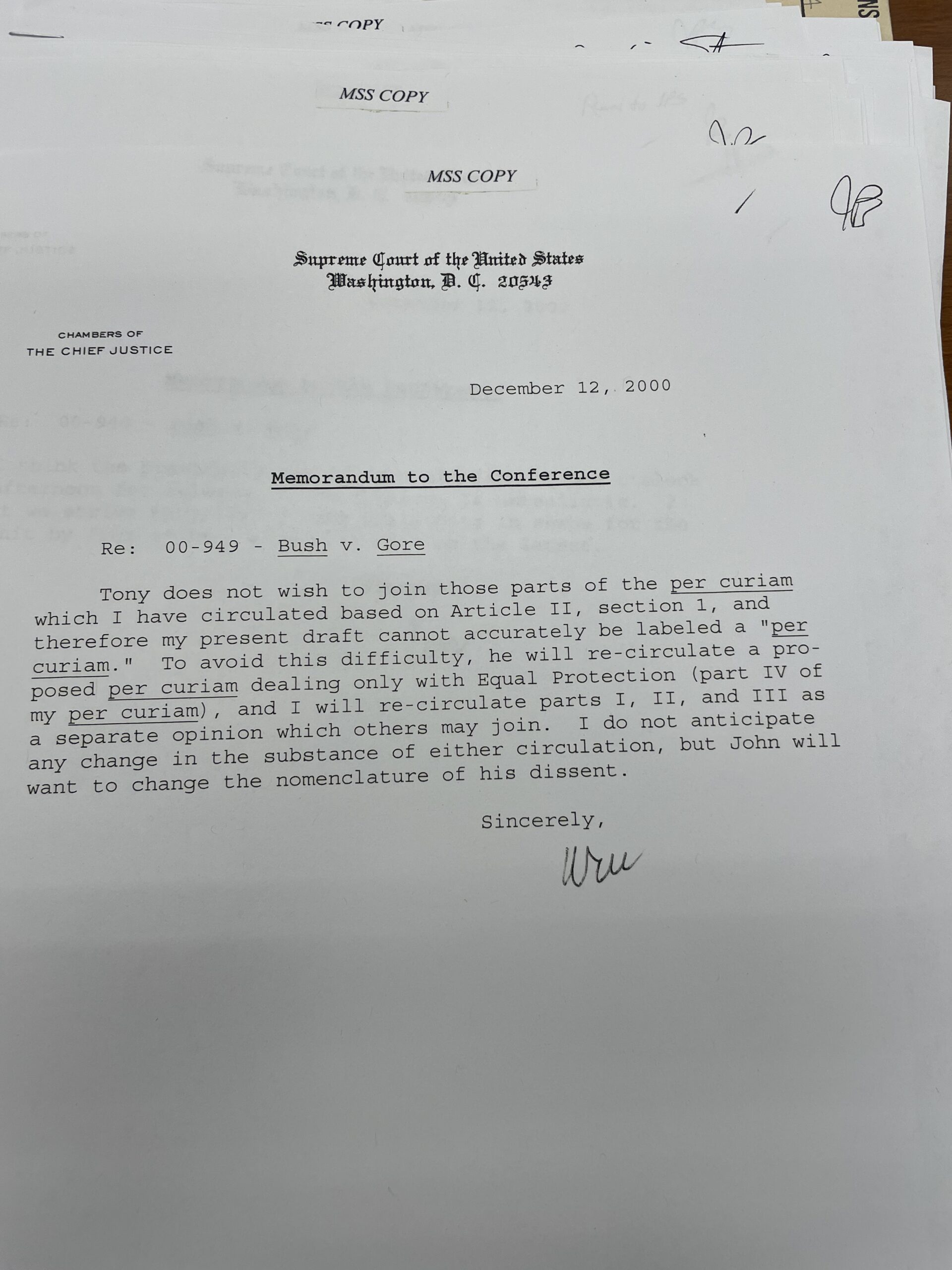
But I did also come across this draft per curiam order in Justice Stevens’ file, which indicates that someone (I think Justice Stevens, because of the handwritten correction) wrote up a proposed order that would have at least kept open the possibility of a recount of Bush and Gore ballots under a uniform standard set by the Florida Supreme Court to be done within six days of the order.
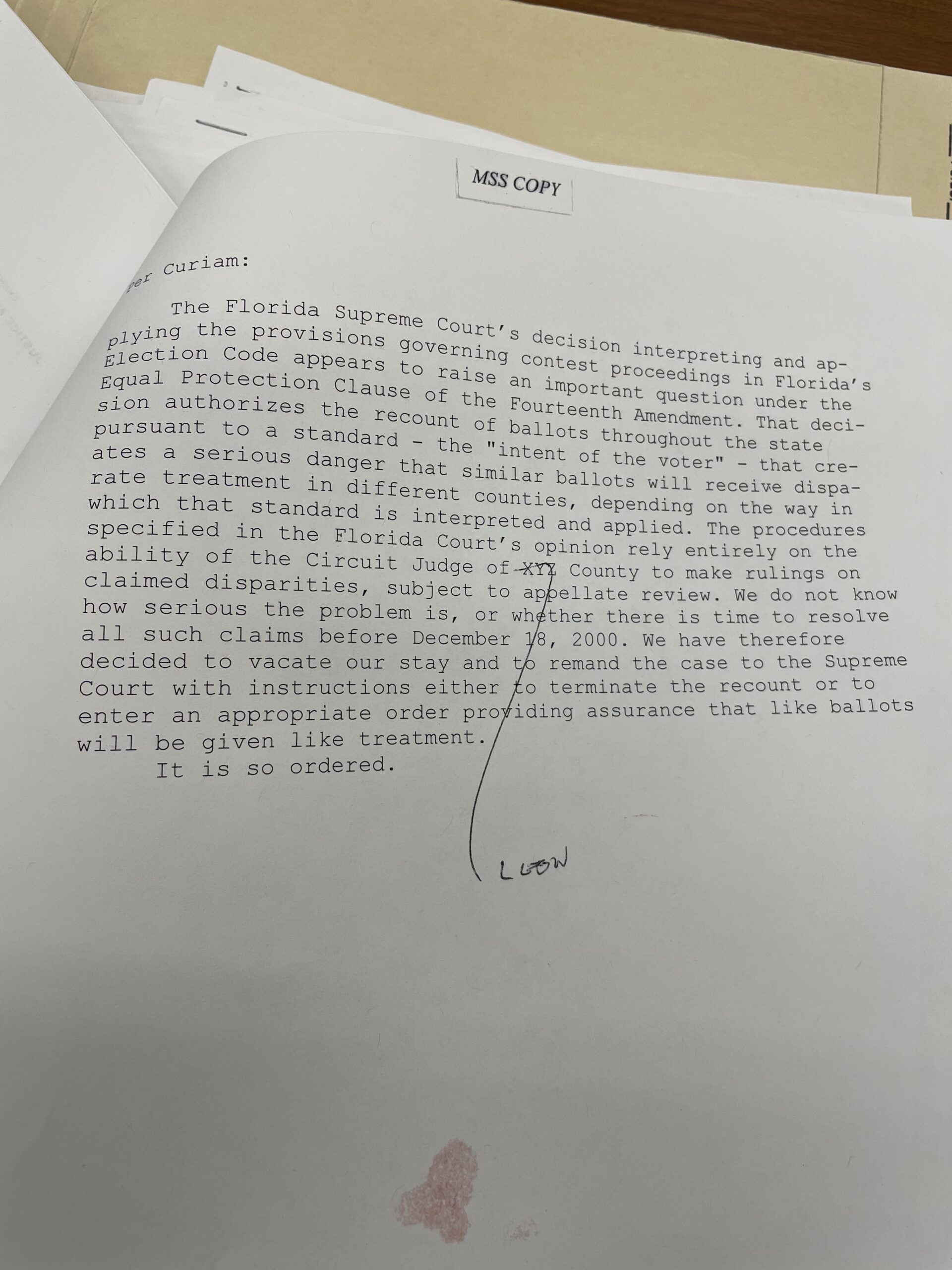
Note the reference at the end of the proposed order to uncertainty as to “whether there is time” to resolve claims about uniform standards “before December 18, 2000,” and with instructions to the Florida Supreme Court “either to terminate the recount or to enter an appropriate order providing assurance that like ballots will be given like treatment.”
I don’t know from my quick review of the file if this was circulated to any other Justices, but I did not see any such indication in the file.
The Curious Failure to Cite to Rehnquist’s Bush v. Gore Concurrence and the Independent State Legislature Theory in 2004 Salazar Case; The Issue Was Clear to Justice Stevens’ Then-Clerk (and Now-CA Supreme Court Justice) Leondra Kruger
As the independent state legislature theory remains in limbo in Moore v. Harper, I’ve thought back on Chief Justice Rehnquist’s dissent from denial of cert in Colorado General Assembly v. Salazar (2004) (a case that few other than Derek Muller and I have paid much attention to). As Derek recently explained:
The Colorado Supreme Court in 2003 found that the state constitution precluded the legislature from mid-decade redistricting. That was despite the fact that the 2002 congressional map was implemented by a state court because the Assembly had failed to pass a congressional redistricting plan in time. The legislature wanted a shot at drawing a map in 2003. No dice, said the Colorado Supreme Court. The assembly appealed, citing its power to as the “legislature” to determine the manner of elections under the Elections Clause.
The Court denied cert in 2004. Chief Justice Rehnquist, joined by Justices Scalia and Thomas, dissented, relying on a version of his concurring opinion in Bush v. Gore (without citing it, opting, instead, to cite McPherson v. Blacker (1892) with a “cf.” signal): “Legislature” must mean something under Article I of the Constitution, and here the institutional legislature has been cut out of the process.
I have always been curious about the failure of the Chief Justice to cite his own Bush v. Gore concurrence which was directly on point. Surely it must have occurred to him to do so and he decided not to do so because the case was so controversial at the time.
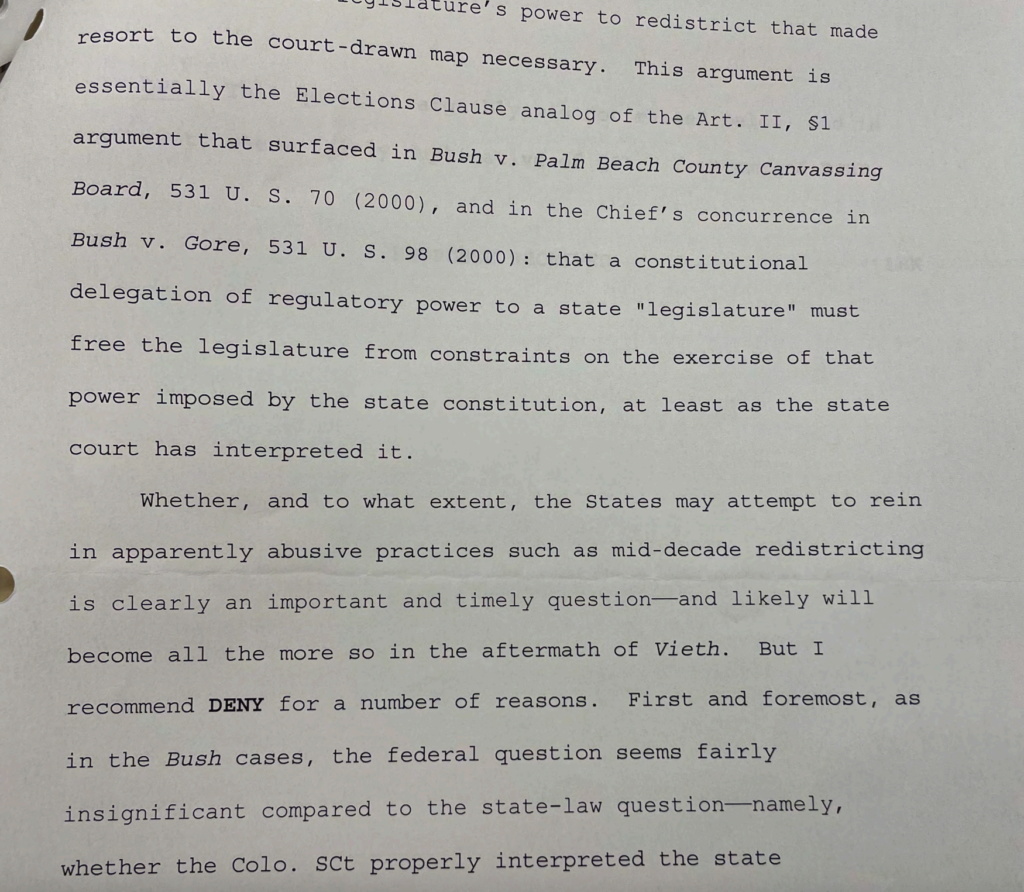
I took a look this week at the (very thin) Salazar file in the newly released papers of Justice Stevens. Nothing there directly sheds light on Rehnquist’s citation decision, but the issue was flagged by then-clerk and now California Supreme Court Justice Leondra Kruger in her memo to Justice Stevens recommending a cert denial in the case:
Why did Justice O’Connor abandon her own Article II argument in Bush v. Gore?
Yesterday, I looked at the draft memorandum Justice Sandra Day O’Connor circulated on December 10, 2000, ahead of the December 11 oral argument in Bush v. Gore. Her memorandum focused on Article II. By December 12, however, the per curiam opinion was released with an Equal Protection Clause argument as its basis, and her argument on Article II was left to Chief Justice William Rehnquist to make in a concurring opinion.
Why did she abandon it? We have some details from a 2004 Vanity Fair story, which essentially parrots the timeline we see from the documents released this week, but we still do not have a great answer.
Continue reading Why did Justice O’Connor abandon her own Article II argument in Bush v. Gore?Justice O’Connor created the framework and the heart of the language for Chief Justice Rehnquist’s concurring opinion in Bush v. Gore
Many of the papers of the late Justice John Paul Stevens have been released, including papers from Bush v. Gore. Over at CNN, Joan Biskupic has a four-page memorandum that Justice Sandra Day O’Connor circulated to the justices before oral argument. The text of that memorandum is here. Biskupic reports the memo “provided the early framework that steered the outcome in the dispute over the 2000 presidential election,” but that’s not accurate–in fact, it gets it exactly backwards. O’Connor’s memo provided the template for Chief Justice William Rehnquist’s opinion, which ultimately became the concurring opinion. When Justice Anthony Kennedy shifted to an Equal Protection rationale, O’Connor later joined him–and abandoned her own draft.
O’Connor’s memo never mentions the Equal Protection Clause. But she opens with Article II: “Our Constitution vests each state legislature with plenary authority to direct the manner of the appointment of that State’s presidential electors. Art. II, §1, cl. 2; see also Bush v. Palm Beach County Canvassing Bd., 531 U. S. __ (2000); McPherson v. Blacker, 146 U. S. 1 (1892). This power is expressly granted to the ‘Legislature’ of each State and not to any other arm of state government. Art. II, §1, cl. 2. As a result, any significant deviation from the state legislature’s scheme for appointing presidential electors presents a federal constitutional question.” And she concludes, “I am concerned that the Florida Supreme Court transgressed the lines of authority drawn by Article II of the Federal Constitution in substantially changing the state legislature’s statutory scheme for the appointment of presidential electors.”
This is precisely the rationale pressed in Rehnquist’s concurring opinion. In fact, Rehnquist’s opinion in Bush v. Gore lifts entire paragraphs from O’Connor’s memo. Here are four such paragraphs, side by side (O’Connor’s December 10 memo on the left, Rehnquist’s concurring opinion on the right):
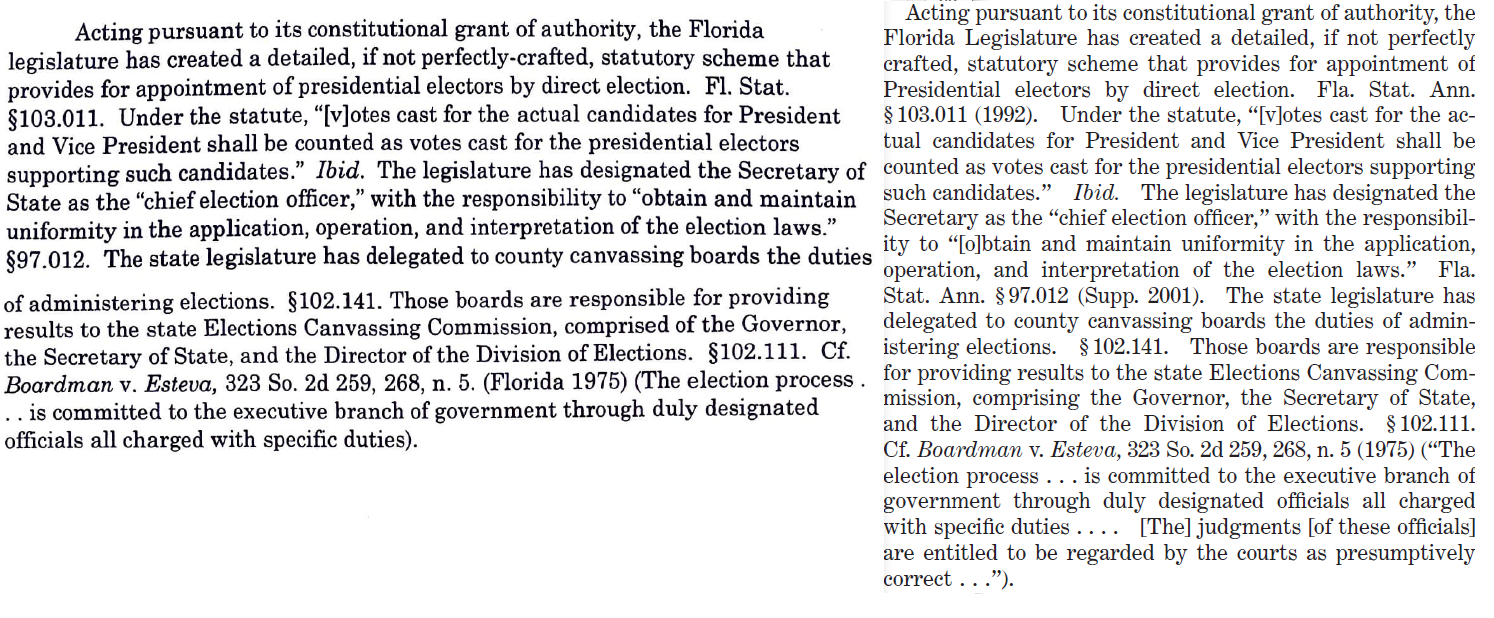

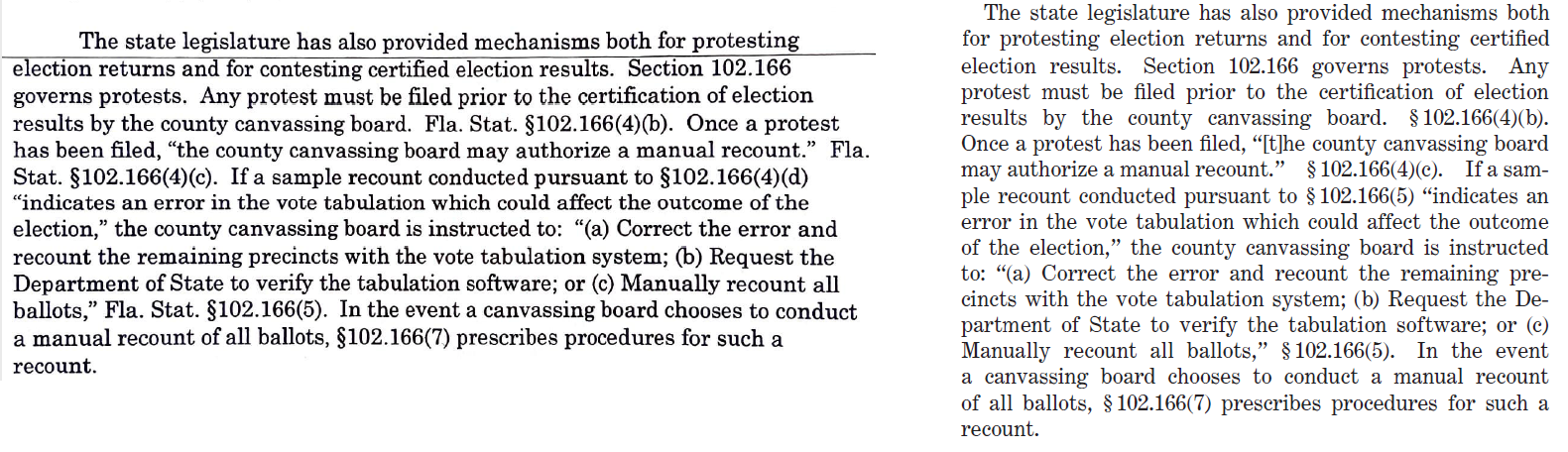
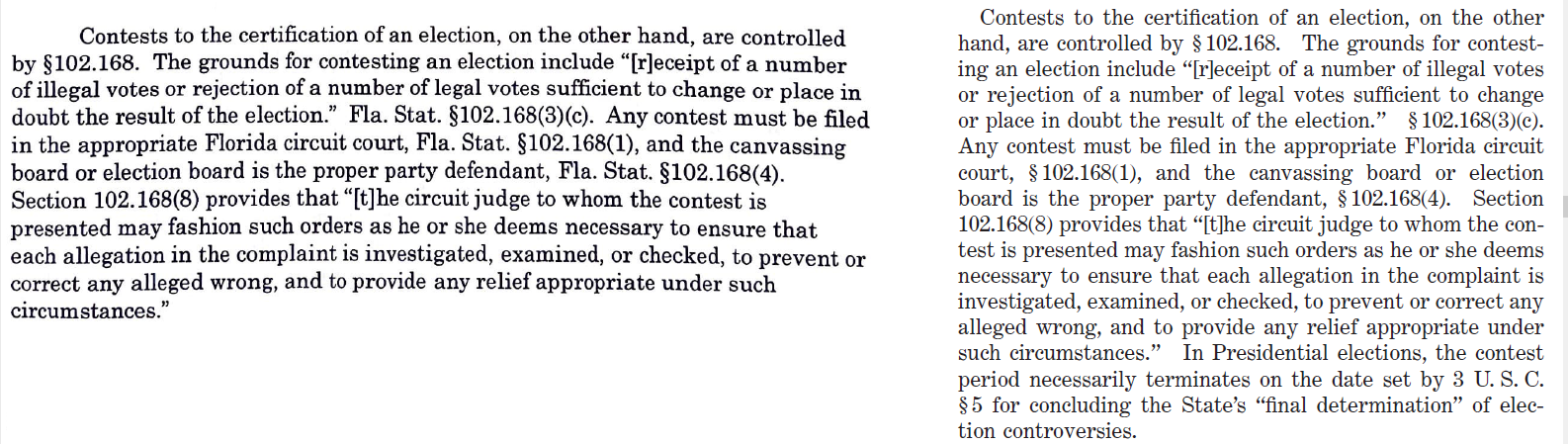
Rehnquist’s opinion borrows other arguments from O’Connor’s memo, too. You can read through to see how similar the argument is structured.
That’s not to say O’Connor’s memorandum was only limited to influencing Rehnquist’s opinion. Her language influenced the per curiam opinion, too. For instance, O’Connor noted in her memorandum, “The county canvassing boards were forced to pull together ad hoc teams comprised of judges from various circuits who had no previous training in handling and interpreting ballots. Furthermore, while others were permitted to observe, they were prohibited from objecting during the recount.” That exact language was put into the per curiam opinion as an Equal Protection concern, instead of a concern of deviating from the legislature’s statutory scheme.
But it is to say that O’Connor set out the framework and the heart of the language in an opinion Rehnquist hoped to write on behalf of the Court. Once Kennedy rejected the argument and moved in a different direction, however, O’Connor shifted to Kennedy’s view, abandoning her own argument and leaving it to Rehnquist to make the argument in his name.
“Bush v. Gore docs among new releases from Justice Stevens archives”
What Difference Would It Make If the Supreme Court in the Moore v. Harper Case Embraced the Bush v. Gore Concurrence Rather Than a Full-Throated Independent State Legislature Theory?
In my earlier recap of today’s oral argument in Moore v. Harper (transcript here), I suggested that the middle ground position that the three Justices in the middle might embrace would be bad but not awful compared to the position embraced by Alito, Gorsuch and Thomas. I want to unpack that here, in the context of all the talk at oral argument about sky high deference to state court rulings etc. And this involves understanding the position of the concurrence in Bush v. Gore and the position of the court in the earlier Bush v. Palm Beach County Canvassing Board case.
Under the vision of ISLT embraced by the Legislators’ today through David Thompson’s argument, a state court has no role to play in applying the state constitution to limit a state legislature’s actions in federal elections. Even assuming the state was applying the state constitution exactly correctly—as Thompson conceded the Court did for purposes of making his argument—the state violates ISLT. There is no role for the state constitution. So imagine a state rules (as PA’s Supreme Court did) that the state constitution’s provision protecting free and fair elections required extending the deadline set by the Legislature by 3 days for the receipt of absentee ballots during a pandemic. Under this version of ISLT, this rule cannot apply to the federal candidates on the ballot. So late arriving ballots would count for state elections but not federal elections. (It would also seem to call into question all of the rulings of state election administrators interpreting state statutes, as I argue in my amicus brief, though Thompson tried to distinguish such cases as oral argument: “First of all, our theory does not relate to the interpretation of statutes.”)
In contrast is the approach that seemed to be floated by Justice Kavanaugh, and to a lesser extent the Chief Justice and Justice Barrett: that of the Bush v. Gore concurrence. Recall in Bush v. Gore the majority held that the recount ordered by the Florida Supreme Court violated the equal protection clause because it treated some voters as worse than others. The Rehnquist concurrence, joined by Justices Scalia and Thomas) held that when a state court engages in grossly unfair interpretation of a state election statute, that could usurp the power of the state legislature. (In Bush v. Gore, it was the legislature’s power under the parallel Article II authority for presidential elections, not the Article I, section 4 authority for congressional elections.) This was kind of the theory that Neal Katyal for the Common Cause respondents was arguing as a backup. There are going to be some really crazy interpretations of state law that would be unconstitutional. (There was some discussion if there’s a different standard in statutory cases like Bush v. Gore or constitutional standards under Bush v. Palm Beach County Canvassing Board. I don’t think that there’s any real holding in Palm Beach County because that case was a remand for more information, and no holding that a crazy interpretation of the state constitution necessarily usurps the legislature’s power unconstitutionally.)
Under this alternative theory, state court retains a role in applying a state constitution to limit what a state legislature does in regulating federal elections. But when it engages in a really crazy interpretation of a state constitution, then the Supreme Court can step in. To return to the example of the extension of 3 days for the return of absentee ballots during the election, the question would be whether such an interpretation of the state constitution—given the text of the statutory provision and given the history of application of the statute—is so novel and crazy as to become unconstitutional.
This version of ISLT would still be bad: we would have the Supreme Court second-guessing state supreme court rulings in highly charged election cases sometimes during contentious presidential elections. That’s why it’s bad. But it is not as awful as cutting courts out completely of the business of protecting voters’ constitutional rights under state constitutions in federal elections. That theory would lead to chaos in the courts, as my amicus brief shows.
Now I do think that there is a better limiting principle here, which is kind of parallel to the crazy interpretation argument: it’s a due process problem. Guy says that what you call it doesn’t matter much where this theory is found by I disagree for two reasons. First the due process clause prevents arbitrary and capricious government action. That’s the appropriate standard to use to decide if the state court has gone way too far. That kind of power would not be bad if the Supreme Court applied it rarely and judiciously. (It’s an interesting question whether it should have applied in Bush v. Gore. My view now is that this was a close call, and that the mainproblem in Bush v. Gore was the failure to remand for a revised recount under a non-arbitrary standard). The due process standard us extremely deferential. Further, the theory would apply to both federal and state elections. So one would not have a ruling that would apply only to federal races on the ballot but not state races.
One final point: if the Court adopts the Bush v. Gore concurrence-version of ISLT in this case, it’s not clear who wins the case given Thompson’s concession. Thompson did not argue that the NC Supreme Court ruling was crazy. Remember, he says any ruling on constitutional grounds is impermissible. So a 6-Justice majority siding with Common Cause? Or a 3-3-3 split where the 3 Justices in the middle decide whether or not the ruling of the NC Supreme Court was crazy? Or asking for more briefing? (One problem with that last course is that the case could become moot. The new Republican majority on the NC Supreme Court is sure to disavow the partisan gerrymandering theory at some point down the line.)
“Private SCOTUS files that could reveal what happened in Bush v. Gore remain locked up”
Internal Supreme Court documents that could enhance public understanding of the Bush v. Gore election battle and other significant cases of the late 1990s and early 2000s were to be opened last year under a deal forged by a long-serving justice, but the high court has delayed release of the materials, citing the pandemic.
The late Justice John Paul Stevens, whose tenure spanned 35 years, planned for most of his case files to be opened and “freely available” at the Library of Congress by October 2020. His arrangement with the library — the details of which have not been previously reported — covers cases up to October 1, 2005.
Along with the 2000 Bush v. Gore decision that continues to reverberate in election-law controversies, the trove would include documents related to two groundbreaking gay-rights decisions, a seminal University of Michigan affirmative action dispute and several post-9/11 Guantanamo detainee appeals.
Twenty Years After Bush v. Gore, America Has Learned the Key Wrong Lesson
Today marks the 20th anniversary of Bush v. Gore. On the case’s 10th anniversary, I remarked that perhaps the anniversary would go more unnoticed on the 20th anniversary than the 10th, as many students I teach now about the case would have been in diapers back on Dec. 12, 2000. Unfortunately, I think the shadow of Bush v. Gore now looms larger than it did 20 years ago. It’s lesson to fight in every possible court over election rules hangs over our election system, and that events in recent days could have been at least somewhat averted had we learned the right lessons from 20 years ago.
Twenty years ago, we suffered from a hyperdecentralized, partisan election system, filled with pockets of election administrator incompetence and faulty voting machinery. The good news is that the country is much better at running elections and many fewer voters have their votes lost because of poor voting systems. I don’t mean to minimize those accomplishments in this post.
But it also became clear in Bush v. Gore that in very close elections, the rules of the game matter and that in close enough elections litigating over election results is possible. What’s happened since then, according to statistics I’ve compiled for my book Election Meltdown, is a near tripling of litigation in the post-2000 period compared to the pre-2000 period. 2018 set a record for election litigation, that surely will be be broken when I compile 2020 statistics.
The difference this time around is that we didn’t even need a close election for there to be extensive litigation. All it took is someone who is unwilling to concede a lost election and a willingness to raise (and reraise) frivolous claims. While the courts and decisionmakers from both parties courageously held the line (and deserve all the commendations for it), many Republicans were willing to endorse an anti-American antidemocratic gambit to steal the election through a frivolous legal theory. It is great that the courts held, but there will be no consequences (and perhaps even rewards like a pardon for Ken Paxton) to come out of the latest debacle. And Trump’s false claims of fraud will no doubt be the predicate for a new round of voter suppression measures to come in some Republican states.
Maybe this is just Trump, and he’s sui generis and things will revert to more normalcy in running elections and considering whether to bring election litigation in future elections. But I’m skeptical.
We could have done much more to fix our broken election system after Bush v. Gore, like having national nonpartisan election administration insulated from presidential control with greater uniformity of rules. This is the model of other advanced democracies around the world. If we couldn’t go that far, Congress could have established more uniform rules for elections, which could have helped during covid. Other countries are able to run elections during a pandemic without precipitating a 5-week-and-counting national crisis.
Bush v. Gore taught political operatives the key lesson to fight over every vote, and some that it is okay to try to make it harder from some people to vote to gain political advantage. Rather than create systems that make such litigation less likely to succeed, protect voting rights, and that bolster public support for our election process, we now have quadrennial angst over whether we can avoid an election meltdown after some states pass new voting restrictions in the name of preventing phantom fraud.
Trump or no Trump, Bush v. Gore has taught every presidential campaign the necessity of having election lawyers ready to go in battles across the country in a system where the rules of engagement remain uncertain. This is not normal for an election system, and it is putting our democracy under great stress. The problems won’t go away until we fundamentally rework how we conduct American elections.
From the ELB Archives: Six Reflections on Bush v. Gore (10th Anniversary)
Six Reflections on Bush v. Gore
Posted on by Rick Hasen
Today is the tenth anniversary of the Supreme Court’s decision in Bush v. Gore, ending the Florida recount and handing the 2000 presidential to George W. Bush. Here is a link to the reflections in this series:
Lyle Denniston, That Night at the Courthouse
Ned Foley, Bush v. Gore in Historical Perspective (Moritz)
Heather Gerken, Rethinking the 2000 Fiasco
Rick Hasen, Election Hangover: The Real Legacy of Bush v. Gore (Slate)
Nate Persily, Bush v. Gore in the American Mind
Rick Pildes, That Night Ten Years Ago
After reading Nate’s contribution, I wonder if the 20th anniversary will go even more unnoticed. In my Remedies class, I always teach about the most controversial stay order in history, the Supreme Court’s Dec. 10, 2000 order stopping the statewide recount of undervotes ordered by the Florida Supreme Court. I used to say to my students, with a great laugh: “There was a disputed election in Florida, you may have heard about it.” Now, ten years later, when I teach the same stay order, I say with a completely straight face: “There was a disputed election in Florida, you may have heard about it.” Many of those students were in middle school when Bush v. Gore was decided. In 2020, I’m guessing most students would have been in diapers when the case was decided. Time marches on.
Ned Foley: “Is Texas v. Pennsylvania an obituary for Bush v. Gore?”
The following is a guest post by Ned Foley, on the 20th anniversary of the Supreme Court’s decision in Bush v. Gore:
On the evening before the twentieth anniversary of Bush v. Gore, one of the most infamous Supreme Court cases in U.S. history (if hardly one of the most precedent-generating), the Court summarily disposed of the case that in some ways is the closest comparison to it.
In Texas v Pennsylvania, this year’s case that most directly attempted to have the Court control the outcome of the presidential election—because it was a simultaneous challenge, joined by Donald Trump himself, to the electoral votes of four states, enough to make the difference in the outcome—the Court dismissed the case with a single substantive sentence: “Texas has not demonstrated a judicially cognizable interest in the manner in which another State conducts its elections.”
Just imagine if twenty years ago, the Court had been equally dismissive of then-Governor George W. Bush’s efforts to overturn the recount ordered by the Florida Supreme Court, a single sentence something along the lines of “Petitioners have not demonstrated a sufficient basis for federal judicial interference with the State’s conduct of a recount in an election conduct pursuant to state laws and procedures.” Who knows how history might have turned out differently?
Perhaps nothing much would have changed; Bush still would have prevailed in the recount and thus become president, with all the implications that followed from his presidency, most especially the ill-fated Iraq war. But maybe Gore would have won the recount—although that only would have set the stage for more contestation over the result, with Florida’s legislature appointing a rival slate of electors as it was already considering—with the dispute reaching all the way to Congress, and Gore having to decide whether he as Vice President would have to recognize Governor Jeb Bush’s authority to decisively certify the electors appointed by the legislature rather than the ones appointed pursuant to the court-ordered recount. That scenario, still resulting in George Bush becoming the 43rd president, would have set a different sort of precedent for how to handle these electoral disputes than the Court’s decision in Bush v. Gore.
But Bush v. Gore appeared to judicialize the resolution of a presidential election. Insofar as Texas v. Pennsylvania emphatically refused to judicialize this year’s election, does yesterday decision effectively signal the death of Bush v. Gore? If so, it’s a lethal present for its twentieth birthday.
My guess, and it can only be a guess given the brevity of yesterday’s decision, is that the two cases will sit side-by-side in uneasy tension until the next time the result of a presidential election gets litigated. Until overruled, Bush v. Gore will continue to show that there is at least a range of issues, depending on when and how presented, that are susceptible to judicial resolution and could (at least conceivably) affect the counting of ballots in a way that would change the outcome of the popular vote in a pivotal state to determining an Electoral College majority. At the same time, Texas v. Pennsylvania will now show that not every effort to undo the count of the popular vote in states that will determine the Electoral College outcome can be put in a form palatable to Supreme Court resolution. Next time, commentators will speculate whether a particular case is more like Bush v. Gore or more like Texas v. Pennsylvania—until the Court itself answers that question.
The Court soon may add to the evidence that will affect this analysis. Still left over from all litigation about the 2020 election is the question whether Pennsylvania’s supreme court violated the federal Constitution by improperly deviating from the state’s statutory law concerning the delivery of absentee ballots. The Court may grant cert on this issue, although not in a way that would affect this year’s election, but instead to provide guidance for the future. If the Court does say that the Pennsylvania Supreme Court violated the federal constitutional prerogative of the state’s legislature, the Court will be opening the door to a lot more litigation of this nature—as evidenced most clearly by the Texas case itself, where multiple versions of this claim were rolled into one omnibus lawsuit. The prospect of opening that Pandora’s Box might be enough for the Court to keep it firmly shut, at least for as long as possible.
But even if the Court decides to venture down this road, it would not necessarily want to do so in the procedural posture of deciding who wins the White House. There would be a way to confine these claims to lawsuits brought before ballots are cast, analogous to the Purcell principle regarding the timing of election-related litigation. The only thing that remains true about Bush v. Gore twenty years on is that the Court is not especially comfortable picking presidential winners.
Most assuredly, the justices feel better about themselves—and will have no regrets—having stayed out of Texas v. Pennsylvania, despite all of Trump’s jawboning about their need to get involved, compared to all the heartburn and regrets that Bush v. Gore caused as later admitted even by members of that Court’s majority.
Boies and Olson WaPo oped: “We opposed each other in Bush v. Gore. Now we agree: Biden won.”
Twenty years ago, we represented the opposing sides in Bush v. Gore. We still don’t agree about how the Supreme Court ruled, but we completely agree that nothing in that case — or in the Supreme Court’s decision — supports the challenges now being thrown about in an attempt to undermine President-elect Joe Biden’s victory.
Yet, over the past week, we have heard repeated assertions that the outcome of this election is somehow in doubt, as it was in 2000.
It is not. Biden will be president. There are many areas of policy on which we disagree. But no matter how you voted in this election, that is the clear outcome. The nation’s laws and shared values dictate that Americans now unite to support democracy, national security, the public trust in institutions and the urgent work of the next administration.
It is also important for the public to understand why 2020 bears no resemblance to 2000.
The presidential-election controversies currently playing out in various parts of the country are not repeats of Bush v. Gore.
“Bush v. Gore Veterans See Big Contrast to Current Legal Fight Over Election”
Lawyers involved in the 2000 Bush v. Gore election fight said the legal battle forming over this year’s presidential election stands in contrast to what took place 20 years ago, when the outcome turned on several hundred votes in a single state.
That clash ultimately led to the U.S. Supreme Court’s intervention in Florida’s manual recount effort and Republican George W. Bush prevailing over Democrat Al Gore.
“We are nowhere close to the perfect storm that was 2000,” said Jack Young, who served as Mr. Gore’s recount attorney.
In 2000, the election hinged on 537 votes in Florida, a must-have state for either candidate to pass the threshold of 270 electoral votes. In 2020, President-elect Joe Biden is ahead by tens of thousands of votes in several contested battleground states, and President Trump would need significant legal wins in more than one state to alter the result.
Barry Richard, an election lawyer who served as a lead attorney for Mr. Bush in Florida, said the 2000 legal challenges revolved around ballot designs, antiquated voting equipment and inefficient state statutes.
“Both sides acknowledged the ballots were defective and that many had been rejected by ballot-reading machines that probably shouldn’t have been,” he said. The issue was how to correct it. Officials spent weeks reviewing each ballot by hand.